
A speculator is one who runs risks of which he is aware, and an investor is one who runs risks of which he is unaware.
John Maynard Keynes
Since the day I had the resources to purchase my first classic car, a 1964 Mercury Montclair Breezeway coupe, I’ve had much experience with finding shops that service classic cars. With the Mercury, it was in solid shape, a mix of older restoration and maintained original, even down to the original Ford/Mercury dealership sticker in the engine bay, confirming it has been in Winnipeg for it’s whole existence.
More about the Mercury, first:
It was painted a cream yellow that was quite popular at that mid 1960’s era; it worked well with the black interior this Mercury had. It was equipped with the 390 CID v8, power steering, power brakes, manual windows and column shift automatic. It never had air conditioning, although there was never a need to option it with a/c from the factory; it was a breezy drive with all the windows open and the rear “Breezeway” windshield rolled down as well. The Breezeway window was basically a rear window angled toward the passenger compartment and that was able to roll down into the trunk area, allowing air to flow directly through the interior.
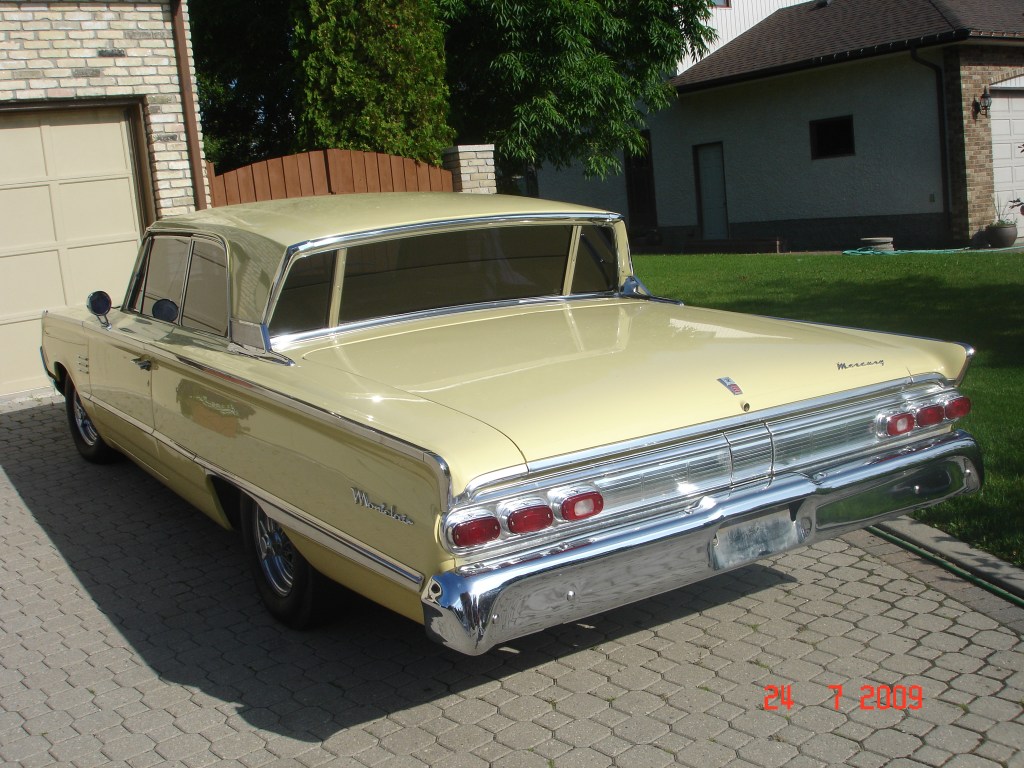
There were issues when I first got it; it had electrical problems causing it to decide to stop running at random if it was raining or cold. There was a shifting issue with the transmission which a shop managed to fix without taking anything apart, thankfully. Someone working there knew how to perform magic! Lastly, it had a tire that was old and worn out that started bulging out on the sidewall, which i was able to catch before it got too serious of a problem. It helped that rarely speed limits in Winnipeg exceeded 80km/h.
At that time in 2008/2009, classic car prices were still grounded in reality and without crazy speculators deciding that something like a Ford Bronco should appreciate the same way a classic Ferrari does. It was a great deal at $6000 at the auction I bought it at, and when I had to sell it in 2010 due to moving to Ontario, I was able to sell it for an amount that covered the original price plus what it cost me to maintain and repair the Mercury. It was an easy driving car, definitely well suited to cruising along at any speed, city or highway. It had a ton of trunk space and back seats that were just as spacious as in the four-door model. It probably had the same wheelbase as the four-door.
To get back to the service and restoration shop discussion; I had little issue finding shops at that time in Winnipeg, and even when coming to Ontario, in the Greater Toronto Area, there was a shop that dealt with classic cars at almost every corner. This was from 2010 to 2016, after which there was a sharp drop in how many shops did work on classic cars. By the time 2020 came around, it was the end of any that didn’t decide to close shop or shift to working on newer cars. I’ve talked about this with many of the people working at or running these shops and the primary reason is that there is nobody training for work specifically on classic cars.
I’ve had to do a large amount of the work myself on my current classic car, a 1963 Daimler 2.5 v8 sedan, as I started working on it seriously in 2022 to get it back in driving condition after sitting for 10+ years. There was a long time it sat with only being started at most once a year, both with me and the previous owner.
Around 2016, more and more news started coming out about classic car after classic car going up in value like a rocket. By the time 2020 came around, they had hit the same levels of increase overnight like what was seen in the art, watch and vintage wine markets. It was a serious venue for investment, no longer just limited to vintage European cars, also.
Now, when you look at the difference between the classic car market and the vintage wine market or art market, for example, there are differences that may as well be neon signs, advertising themselves from miles away. The latter two markets both have an established, strong support industry, which is normal considering the amount of money tied up in these items. Now with classic cars, though, there is less and less of a support industry, no matter where you go in North America. However, nobody seems to notice it or care about it.
Some specific details about the severity of the lack of support industry for classic cars:
– In the Greater Toronto Area, there is only one shop that I could find that has experience with and is even willing to take on electrical repairs for classic cars.
– The number of engine rebuild shops have reduced by at least 3 since 2016.
– There are virtually no transmission shops that have knowledge in classic car transmission repair and service.
– Serious, dedicated restoration shops still in operation in 2023 now number 3-4. This is compared to more than 10 I knew of, before 2019.
– Parts stores for classic cars now are non-existent in the Greater Toronto Area, after the closure of Performance Improvements in 2022.
– Storage for classic cars is difficult to find, as most decent, secure storage warehouses are far out of the city and unrealistic for the average person with a classic car.
About the only thing still readily available is classic car insurance; in some ways even more advanced than it was before 2016, from what I’ve experienced.
I’ve heard from some people with classic cars or experience with them, that there is still a chance to find repair shops through the old-fashioned method of meeting other classic car owners with the same type of car as yours. I can appreciate that and it is possible that this is still productive. However, I’m writing from the ease I had with finding shops in Ontario through searching online back in 2010-2016, as compared to how difficult it has become after 2019.
It would make sense that the classic car support industry would follow the same route as the vintage wine support industry, with more businesses opening and more online marketing being done, to attract a larger client base, especially with the client base including younger generations more each passing year. More and more I’m certain this whole market is unrealistic, having as much in common with a fever dream as everything else in the world since the beginning of the Covid pandemic.
There’s no way it can continue the upward trend, when all of these classic cars primarily have value due to being maintained in top condition.
If nobody knows how to service, repair or restore these cars, what happens then?
It’s almost as if there is a cold war of sorts going on between the older generations and the younger generations. One wants to hold on to what they’ve earned and acquired and the value these cars have, and at the same time many of these same people with the experience to work on these same cars, retiring from the industry without taking into consideration passing on their knowledge.
Of course, both sides of the problem have a role to play. For example, younger generations like mine put too much emphasis on instant gratification. With classic cars, there is nothing instant. Everything feeds off of patience, ingenuity, perseverance and nerves of steel. Newer cars (1980 onward) have electronic systems that allow for easier location and resolution of the cause of issues, be it a faulty sensor or low oil. Also, these same systems create more direct responses when driving; more “instant gratification” in many senses.
I myself struggle with having to wait for anything, it’s a consistent matter of reminding myself to have patience. Being a part of the millennial generation, I’m certainly not immune to the traits and habits associated with it. There’s nothing exciting or amazing about having to wait for results in the short term, although in the long term I can say that the majority of the time I’m not disappointed with the end result. The wait in between is still a mood killer, regardless of how many times i go through the same process and know what good can come after the wait.
Also, a trait that plays a role with lack of interest from younger generations is that there is little to no clear benefit that we can see in doing anything that a) doesn’t benefit us directly and immediately, and b) requires long term dedication and physical labour to produce results.
It’s for this reason that more and more popular are activities that can be enjoyed immediately; Festivals, concerts, hiking, camping, restaurant tours, online shopping.
Any way it is looked at, there is a serious disconnect between generations, which will have a major effect on how the industry and market looks in coming years. If there is less self-interest and more focus put on community, putting aside all differences in political and ideological orientation, there could be much more continuity. Younger people are being pushed out of the classic car market for much of the same reason that they are pushed out of the housing market; nobody wants to give up what they’ve earned from all their years of hard work.
I strongly believe more people should have access to classic cars, without being hostage to the ups and downs and lack of support industry like we currently have. There is too much history to be forgotten and too many life experiences and lessons to be lost out on, for things to continue the way they are.
Make classic cars a labour of love again, rather than a target of speculation. Make the primary reward from the cars the memories they provide, rather than how much their value increases each year.
If trends continue like this, we’ll end up having something to show, although little practical, enjoyable use for classic cars; in other words, no “go”.

 pravaline.ca
Leave a comment